MASSIVE Resource for EVERY MFT Lens - Interactive Database

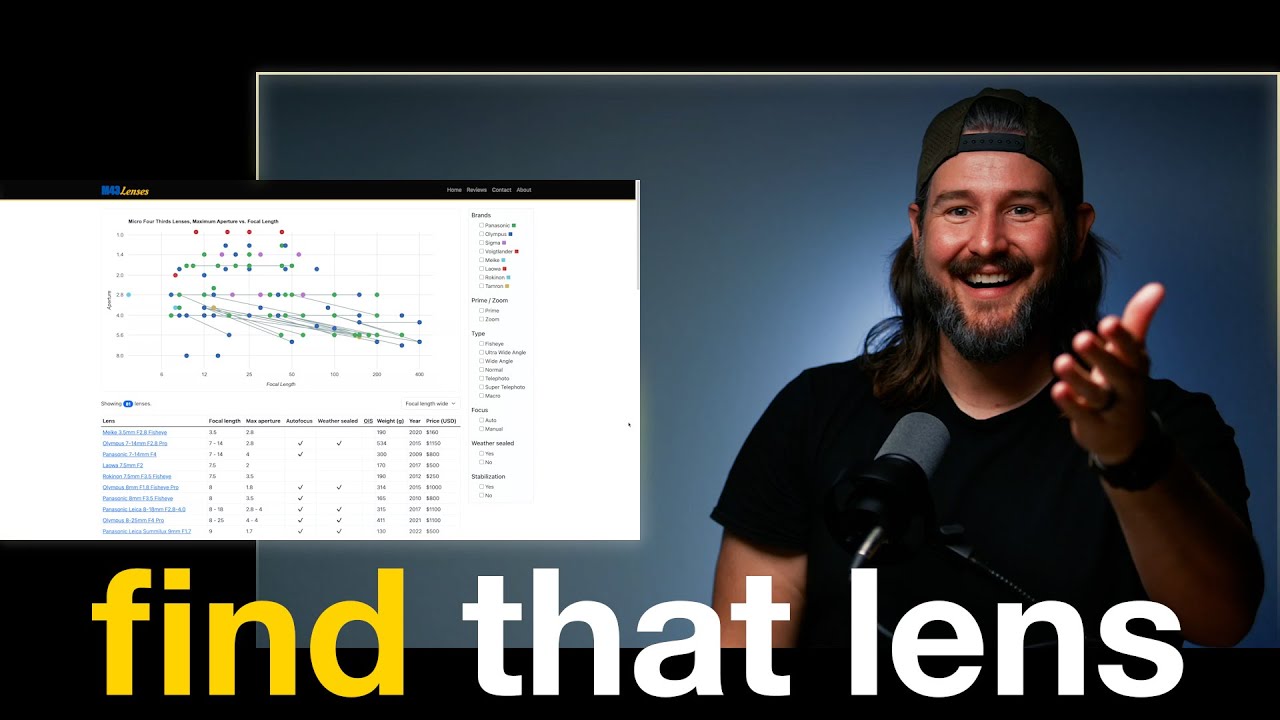
Stop guessing which MFT lens exists and filter your way to the right one
If you shoot Micro Four Thirds, you probably know the feeling. You need a very specific lens for a specific job, but finding it can turn into a messy loop of random review videos, marketplace listings, and half-remembered forum threads. One day you are trying to confirm whether a lens even exists, and the next day you are five tabs deep comparing totally different mounts.
A faster approach is m43lenses.com. It is simple and direct: a chart that maps focal length against aperture, plus filters that narrow the field to exactly what you need. It is not a sponsored recommendation. It is just one of the most useful planning tools you can keep open when your project calls for MFT glass.
This matters even more now because full-frame dominates the conversation. Even if you like full-frame too, MFT still solves real production problems. If you are balancing budget, weight, and flexibility, you can still build a very capable setup. If you want help mapping that setup around your own work style, content consulting is a practical way to pressure-test your decisions before you buy.

How the chart works when you need answers quickly
The core chart is straightforward once you use it for sixty seconds. Aperture runs vertically and focal length runs horizontally. Prime lenses appear as points. Zoom lenses appear as ranges across focal lengths, so you can see coverage at a glance.
That makes impossible requests obvious right away. If you are hunting for something like a 400mm f/1.0 in MFT, the chart quickly shows you that category does not exist. At the same time, it highlights where the very fast options do exist, including well-known Voigtlander Nokton primes. Instead of wasting time searching for unicorn gear, you can immediately move toward real candidates.
If you want a quick technical baseline for how the MFT format is structured and why lens design choices differ from larger formats, the Micro Four Thirds system overview is a useful reference while you compare options.
Use filters to cut noise: brand, lens type, AF, weather sealing, stabilization
The real power is the filter stack. You can isolate Panasonic only, then switch to zoom-only, then apply autofocus, weather sealing, and stabilization requirements. In a few clicks, your giant list collapses to a short set you can actually evaluate.
Once filtered, the table view gives you release year, price context, and focal range so you can compare practical tradeoffs instead of spec-sheet fantasy. This is where your decision gets faster: you can align lens options to your real conditions rather than buying whatever is loudest on social media.
If your work demands high output and tight turnaround, you can pair that lens planning process with a repeatable production framework like the One Day Content Creator Virtual Bootcamp so your gear choices actually serve your publishing cadence.

A real-world example: choosing a fast prime without overbuying
A practical workflow looks like this: set prime only, keep autofocus on, ignore weather sealing if it is not required for this project, and remove stabilization if you do not want it in the lens. Then narrow by focal range and speed until you are in the zone you can afford and carry comfortably.
That process surfaces options you might not otherwise consider. In one case, the shortlist landed on the Olympus 20mm f/1.4 as the best fit for the specific need. Along the way, it also revealed where APS-C-oriented optics were technically mount-compatible but not ideal for the intended result, which prevented a mismatch before checkout.
To sanity check pricing, you can compare new and used listings after you finalize your filtered set. This keeps your research clean: first solve fit, then solve price. If you are unsure about lens behavior in your exact production environment, a targeted strategy session like a 1-hour virtual consult can save you from buying twice.
Hidden gems and ecosystem quirks you should account for
Another benefit of a complete chart is discovery. You find lenses you never think to search manually, including niche macros and less obvious third-party entries. That is helpful when your assignment changes and you need a different tool fast.
You can also compare standout zooms quickly, including popular Panasonic options like the 10-25 and 25-50 ranges, then test what happens when stabilization is required. Sometimes your fastest favorites drop out as soon as OIS becomes mandatory, which is exactly the kind of tradeoff you want to see before a shoot day.
There are still real-world interoperability quirks to keep in mind. Certain Olympus lens stabilization behaviors on some Panasonic bodies have historically produced less-than-ideal video feel in specific pairings, even when both pieces are individually excellent. Firmware updates can improve things, but you should still verify lens-body behavior for your own kit. For broader mount and compatibility background, this MFT lens buying guide is a good secondary source while you shortlist options.

Why this still matters in a full-frame market
Yes, many creators have moved to full-frame. That also means there are often strong deals on used MFT glass if you know exactly what you are looking for. A searchable lens map helps you move with intent instead of reacting to hype cycles.
MFT may be past its peak mindshare, but it is still fully capable for serious photo and video work when your choices are deliberate. If your next project needs a precise focal length, speed, and feature set, this resource helps you find it quickly and confidently.
Start with the chart, filter to your constraints, and build from there. You will spend less time browsing and more time shooting.